
MRI
1.5T at Mission Viejo. 3T at Newport Beach. Subspecialty reads.
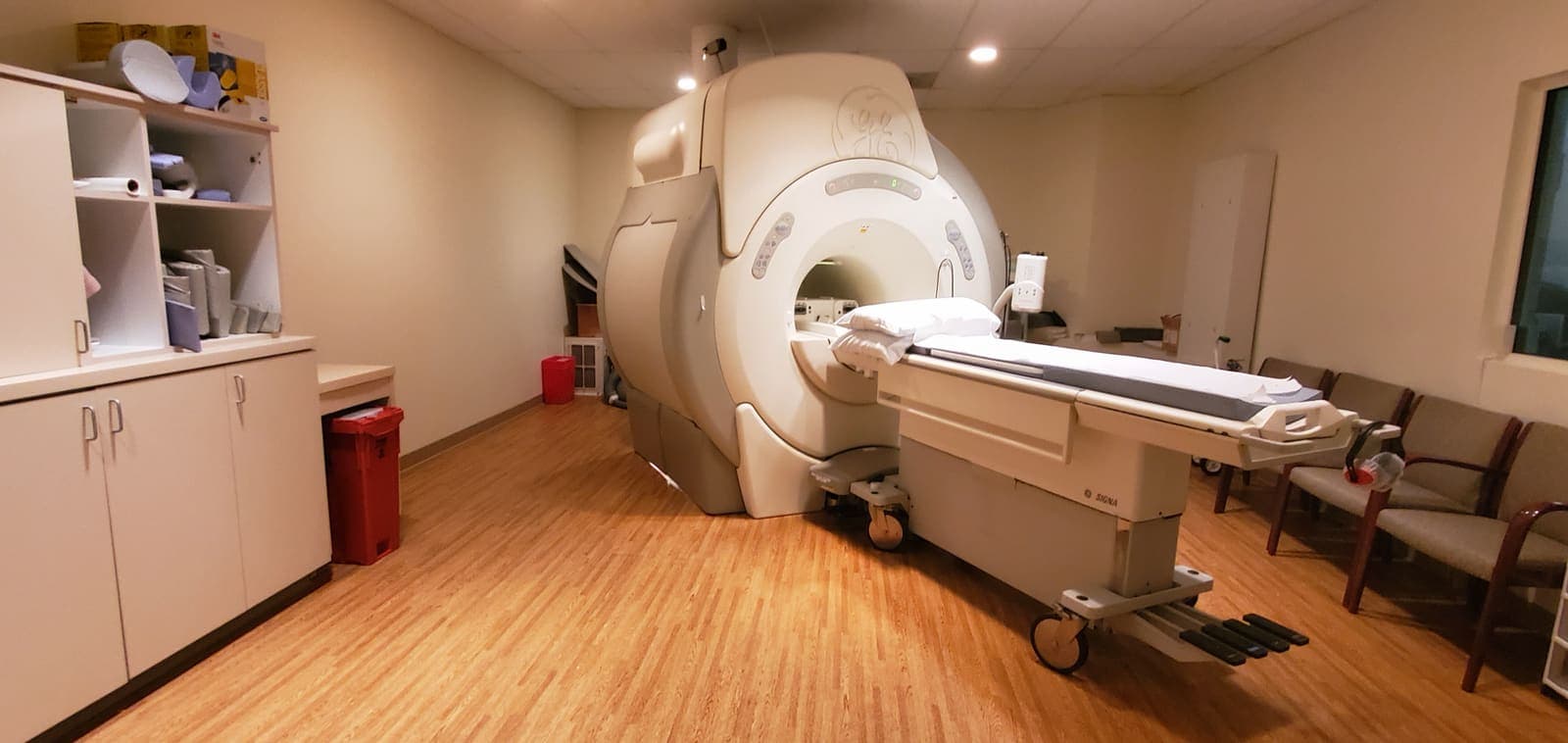
What an MRI is
MRI (magnetic resonance imaging) uses a powerful magnet, radio waves, and a computer to create detailed pictures of the inside of your body — with no radiation at all. It is especially good at showing soft tissue: the brain and spine, joints and ligaments, and organs like the liver and uterus, often in detail that X-ray and CT can't match.
Your physician may order an MRI to investigate pain, evaluate an injury, look more closely at something found on another scan, or monitor a known condition. Common reasons we see every week:
- Back, neck, and shoulder pain (spine and joint MRI)
- Knee, hip, and ankle injuries — meniscus, ligament, and tendon tears
- Headaches and neurological symptoms (brain MRI)
- Abdominal and pelvic conditions, including MRCP of the bile ducts
- Follow-up of known findings at your doctor's requested interval
MRI at Crown Valley: two scanners
| Mission Viejo | Newport Beach | |
|---|---|---|
| Scanner | 1.5 Tesla | 3 Tesla (3T) |
| Best for | The full range of routine MRI | Higher field strength for more detailed imaging |
| Setting | Full-service office, Suite 180 | Dedicated 3T MRI office |
A 3T magnet is twice the field strength of a standard 1.5T, which can produce more detailed images. Your ordering physician — or our schedulers — will help you choose the right location for your exam; many studies are excellent on either scanner.
Both offices are ACR-accredited in MRI — the American College of Radiology's gold-standard, peer-reviewed check of image quality, equipment, and staff qualifications. Every study is read by one of our board-certified, fellowship-trained radiologists, and the report is signed with their name.
What to expect
Before. Most MRI exams need no preparation. If your exam uses contrast, fast for 4 hours beforehand (clear liquids are fine — and if you're diabetic, don't fast). Abdomen, pelvis, and MRCP exams: fast 4 hours including water. Exact prep for your specific exam is in our prep library — the same wording our schedulers text to you.
Check-in. You'll complete an MRI safety screening (see below) and change into a gown if your exam requires it. Leave jewelry and valuables at home when you can.
During. You'll lie on a padded table that slides into the scanner, which is open at both ends. The machine makes loud knocking and tapping sounds while it captures images — that's normal — and we provide hearing protection. Your technologist sees you the whole time and you can talk to them through an intercom. The most important job you have: hold still. Most exams take 30–90 minutes depending on the body part and whether contrast is used.
After. No downtime — you can drive and return to normal activity immediately (unless you took a sedative; see below). Your radiologist reads the study and the signed report goes to your ordering physician — for routine exams, within 48 business hours. Need a copy yourself? Email medicalrecords@cvimaging.net.
MRI safety — what we screen for
The MRI magnet is always on, and it's strong enough to move metal objects — so screening isn't paperwork, it's the safety system. Before your scan we'll ask about:
- Implanted defibrillators (ICDs): we do not scan ICD patients. Because we don't have a cardiac team on site, we can't safely perform MRI — or any imaging — for patients with an implanted defibrillator. If you have an ICD, ask your ordering physician to refer you to a hospital-based imaging facility.
- Pacemakers. We do scan many pacemaker patients — with a coordinated safety process. A pacemaker has to be placed in an MRI-safe mode before the scan, so we work with your device's manufacturer: a representative either comes on site or adjusts the device remotely through equipment we keep in the office. Tell us your exact device make and model when you schedule, and bring your device card, so we can arrange this in advance.
- Other implants — aneurysm clips, cochlear implants, neurostimulators, medication pumps, surgical hardware. Most orthopedic implants are MRI-safe; the exact type matters. Bring documentation if you have it.
- Metal in your body from injury or work (shrapnel, metal fragments in the eyes). Tell us — we may image first to confirm it's safe.
- Pregnancy. Tell us if you are or may be pregnant. MRI has no known risk in pregnancy, but non-urgent exams are often deferred and contrast is avoided as a precaution.
- Everything metal comes off — phones, watches, hearing aids, keys, cards, jewelry, clothing with metal fasteners.
About contrast (gadolinium)
Some MRI exams use a gadolinium-based contrast agent, given through an IV, to make certain tissue easier to see. Gadolinium contains no iodine and rarely causes allergic reactions. We follow current American College of Radiology (ACR) and MRI-safety guidance for every contrast exam — so tell us beforehand if you:
- have kidney disease, a kidney transplant, or reduced kidney function — recent blood work may be required before we give contrast;
- have ever reacted to MRI contrast;
- are or may be pregnant — we avoid contrast in pregnancy unless it's essential.
Claustrophobic? You have options.
You're not alone — it's one of the most common concerns we hear, and most patients do better than they expect. Our scanners are open at both ends, you're never out of contact with your technologist, and for many exams you go in feet-first. If you think you'll need a sedative: ask your primary care or referring physician to prescribe one before your appointment — they handle that process — and arrange a driver for the day of your exam.
What it costs
Self-pay MRI at Crown Valley starts at $665.50, and the price we quote is the price you pay — request a Good Faith Estimate to get it in writing. If you're using insurance, we verify your eligibility and handle any pre-authorization with your insurer. Your out-of-pocket cost depends on your plan's deductible and coverage — your insurer can confirm exactly what you'll owe.
The setting you choose changes the price more than anything else. Hospital prices for common imaging run 2 to 6 times higher than Medicare rates, and hospital outpatient imaging has been found to cost roughly 2 to 3 times more than the same study in an independent, office-based setting like ours. We're the lower-cost setting for the very same scan.
Frequently asked questions
- Most exams take 30–90 minutes depending on the body part and whether contrast is used. Plan on being with us a little longer for check-in and screening.
- No. MRI uses a magnetic field and radio waves — no ionizing radiation.
- The knocking and tapping is the normal sound of the magnet's gradient coils switching during imaging. We provide earplugs or headphones.
- Often yes — most orthopedic hardware is safe, and many modern devices are MR-conditional. The exact type matters, which is why we screen carefully. Bring your implant card or surgical records. One exception: we do not scan patients with an implanted defibrillator (ICD) — there's no cardiac team on site, so those exams must be done at a hospital-based facility.
- Tell us when you schedule. Scanners are open at both ends, many exams go feet-first, and your doctor can prescribe a mild sedative for the appointment (bring a driver).
- Only for contrast exams (4 hours; diabetics should not fast) and abdomen/pelvis/MRCP studies (4 hours including water). Otherwise, no prep — check your exam's exact prep at /prep/mri.
- Your report goes to your ordering physician after our radiologist signs it — for routine exams, within 48 business hours. For your own copy, contact medicalrecords@cvimaging.net.
- Whichever your physician ordered works well. Our 3T scanner in Newport Beach offers higher field strength for more detailed imaging; our 1.5T in Mission Viejo handles the full range of exams. Many studies are excellent on either — we'll guide you when you schedule.