
CT Scan
Low-dose 64-slice CT with and without contrast. Mission Viejo only.
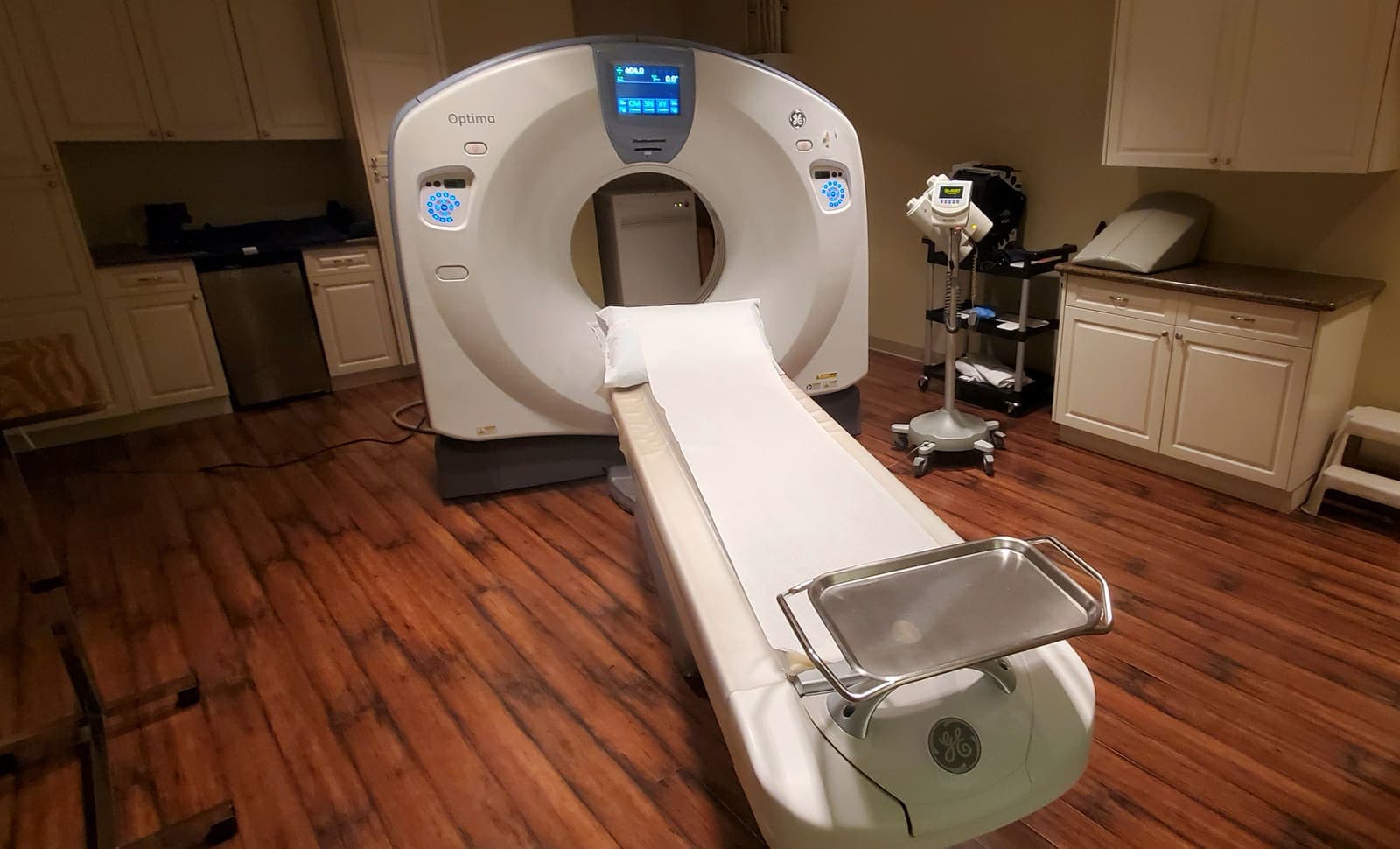
What a CT scan is
A CT (computed tomography) scan uses a rotating X-ray beam and a computer to build detailed cross-sectional images of your body — like looking at one thin slice at a time. It's fast (the scanning itself takes seconds to minutes), painless, and excellent at showing bone, soft tissue, and blood vessels in a single exam.
Physicians order CT to:
- Evaluate abdominal or pelvic pain and find its cause
- Look at the lungs and chest, including low-dose lung cancer screening
- Detect kidney stones — fast and without contrast
- Find or follow tumors and monitor treatment
- Examine sinuses, the spine, and complex fractures
- Assess blood vessels with CT angiography (CTA)
CT at Crown Valley: low-dose, 64-slice
CT at our Mission Viejo office runs on a 64-slice low-dose scanner — multidetector technology that captures thin slices quickly, which means shorter breath-holds, less motion blur, and careful attention to radiation dose. The exam itself usually takes 10–20 minutes door to door.
We are ACR-accredited in CT — the American College of Radiology's peer-reviewed standard for image quality, dose, equipment, and staff qualifications. Every scan is read by a board-certified, fellowship-trained radiologist who signs the report by name.
Beyond doctor-ordered diagnostic CT, two of our most-requested screening exams are CT-based and don't require a physician order:
- CT Cardiac Calcium Scoring — $361.90 self-pay; quantifies coronary artery calcium to help gauge heart-disease risk. No caffeine 4 hours prior; not appropriate with a coronary stent.
- CT Whole Body Scan — $845.79 self-pay; head-to-pelvis low-dose survey including the calcium score.
We also perform CT Myelography by physician order, scheduled Tuesday and Thursday mornings (8 a.m.–12 p.m.).
What to expect
Before. No prep for non-contrast CT. If your exam uses IV contrast, fast for 4 hours beforehand — but if you're diabetic, don't fast. Your exam's exact prep is in our prep library, word-for-word what our schedulers send.
During. You'll lie on a table that moves through a short, open donut-shaped ring (much shorter and more open than an MRI — claustrophobia is rarely an issue with CT). The technologist may ask you to hold your breath for a few seconds to keep images sharp. If your exam uses IV contrast, you may feel briefly warm or notice a metallic taste — both normal and short-lived.
After. No downtime; resume normal activity right away. If you received contrast, drinking water afterward helps your body clear it. Your radiologist's signed report goes to your ordering physician — for routine exams, within 48 business hours; for a personal copy, email medicalrecords@cvimaging.net.
About radiation dose — an honest answer
CT does use X-rays, and we take that seriously: our protocols are low-dose, our scanner is ACR-accredited (which audits dose), and no radiation stays in your body after the exam. The radiation from one CT is small, and there is no conclusive evidence that doses at CT levels cause harm — but no imaging is ordered casually: the standard your physician applies is that the diagnostic benefit outweighs the small theoretical risk. If you're pregnant or may be, tell us before scheduling.
About CT contrast (iodinated)
Some CT exams use an iodine-based contrast agent — injected through an IV, swallowed, or both — to make organs and vessels stand out.
- A shellfish allergy does not affect CT contrast. That's a persistent myth; tell us about any allergies, but shellfish does not rule out contrast.
- Kidney function and medications matter. If you have kidney disease — or take certain medications, including some diabetes drugs such as metformin — recent blood work may be required before a contrast exam, and we may ask you to hold a medication around the scan. We follow current American College of Radiology (ACR) guidance, so tell us your full medication list and any kidney history when you schedule.
- Prior contrast reactions: tell us when you schedule. If you've had a reaction to contrast before, we follow ACR guidance, which may include a premedication protocol arranged with your ordering physician.
What it costs
Self-pay CT at Crown Valley starts at $467.50 — quoted up front, no surprise bill to follow; request a Good Faith Estimate to get it in writing. If you're using insurance, we verify your eligibility and handle any pre-authorization. Your out-of-pocket cost depends on your plan's deductible and coverage — your insurer can confirm exactly what you'll owe.
Where you have the scan matters. Hospital prices for common imaging run 2 to 6 times higher than Medicare rates, and hospital outpatient imaging has been found to run roughly 2 to 3 times more than the same scan in an independent, office-based setting — which is exactly what we are.
Frequently asked questions
- Usually 10–20 minutes in the office; the actual scanning takes seconds to a few minutes.
- Yes for non-contrast exams. With IV contrast: fast 4 hours (diabetics should not fast). Check your exam's exact prep at /prep/ct.
- The radiation dose from a modern low-dose CT is small, nothing remains in your body afterward, and your physician ordered it because the diagnostic benefit outweighs the small theoretical risk. Tell us if you're pregnant.
- Yes. Shellfish allergy does not affect CT contrast. Tell us about any prior reaction to contrast itself.
- CT is faster, more open, and excellent for bone, lungs, and acute problems like kidney stones. MRI takes longer but shows soft tissue (brain, spine, joints, organs) in finer detail — with no radiation. Your physician picks the right tool for the question being asked.
- For diagnostic CT, yes. Two screening exams don't need one: cardiac calcium scoring ($361.90) and the whole-body scan ($845.79) — both bookable directly.
- A brief flush of warmth and a metallic taste are normal effects of iodinated contrast and pass quickly.
- Your report goes to your ordering physician once our radiologist signs it — for routine exams, within 48 business hours. For your own copy: medicalrecords@cvimaging.net.